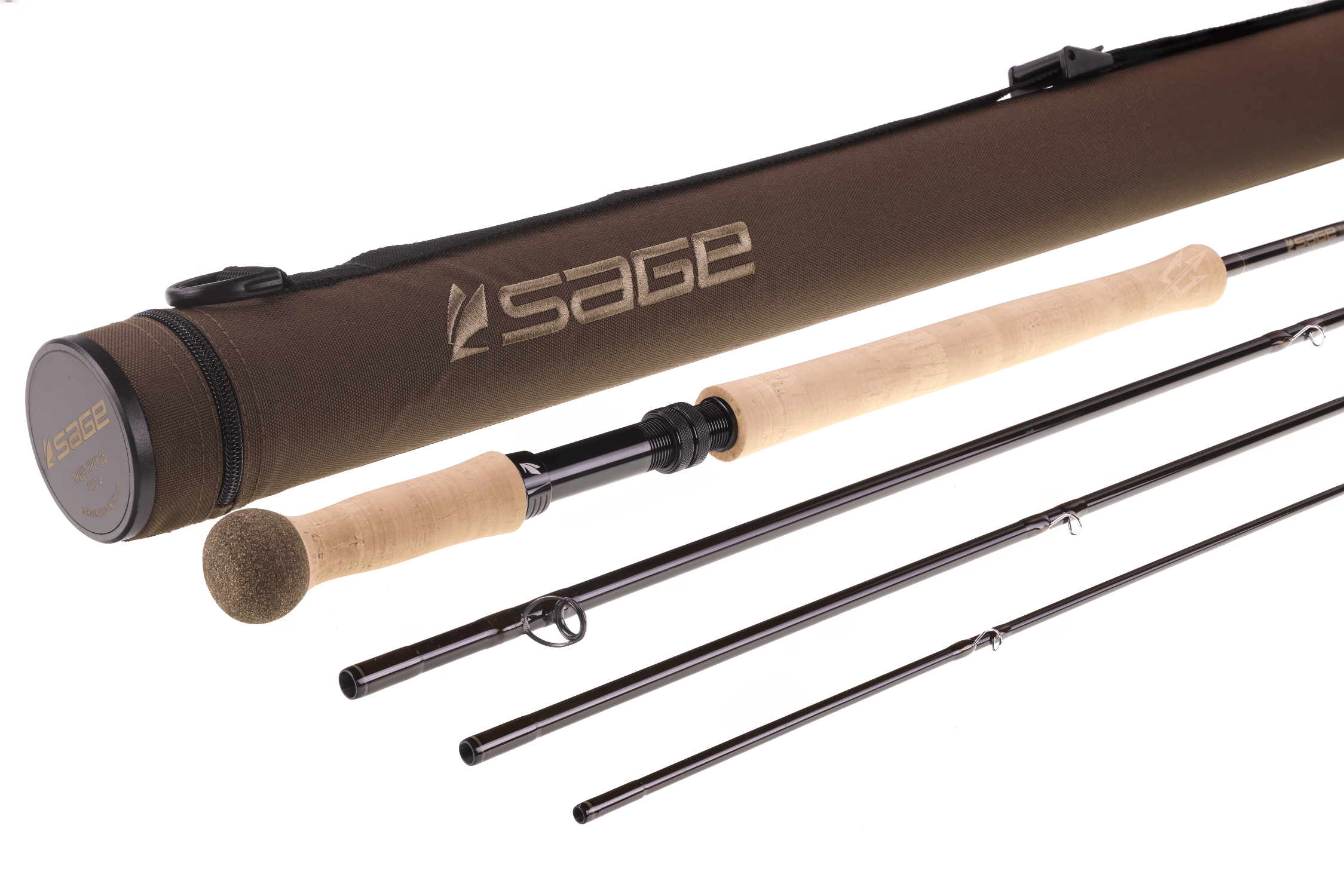
The Sage Trout Spey G5 Trout Spey Rod is built for the water most of us actually fish, a run you can wade across, holding trout that eat a swung soft hackle. The down-and-across swing is one of the most efficient ways to cover that water, and a two-handed rod does it with no back cast and no double haul: lift, set the anchor, fire. What trips people up is the line. A trout spey rod works in a grain window a fraction of the size a steelhead rod wants, so the head left over from last fall will either overload the blank or never load it at all. Sage builds the G5 to published windows between 250 and 400 grains and sizes the line guides for modern trout spey heads, both Skagit and short Scandi, and the running lines that go with them.
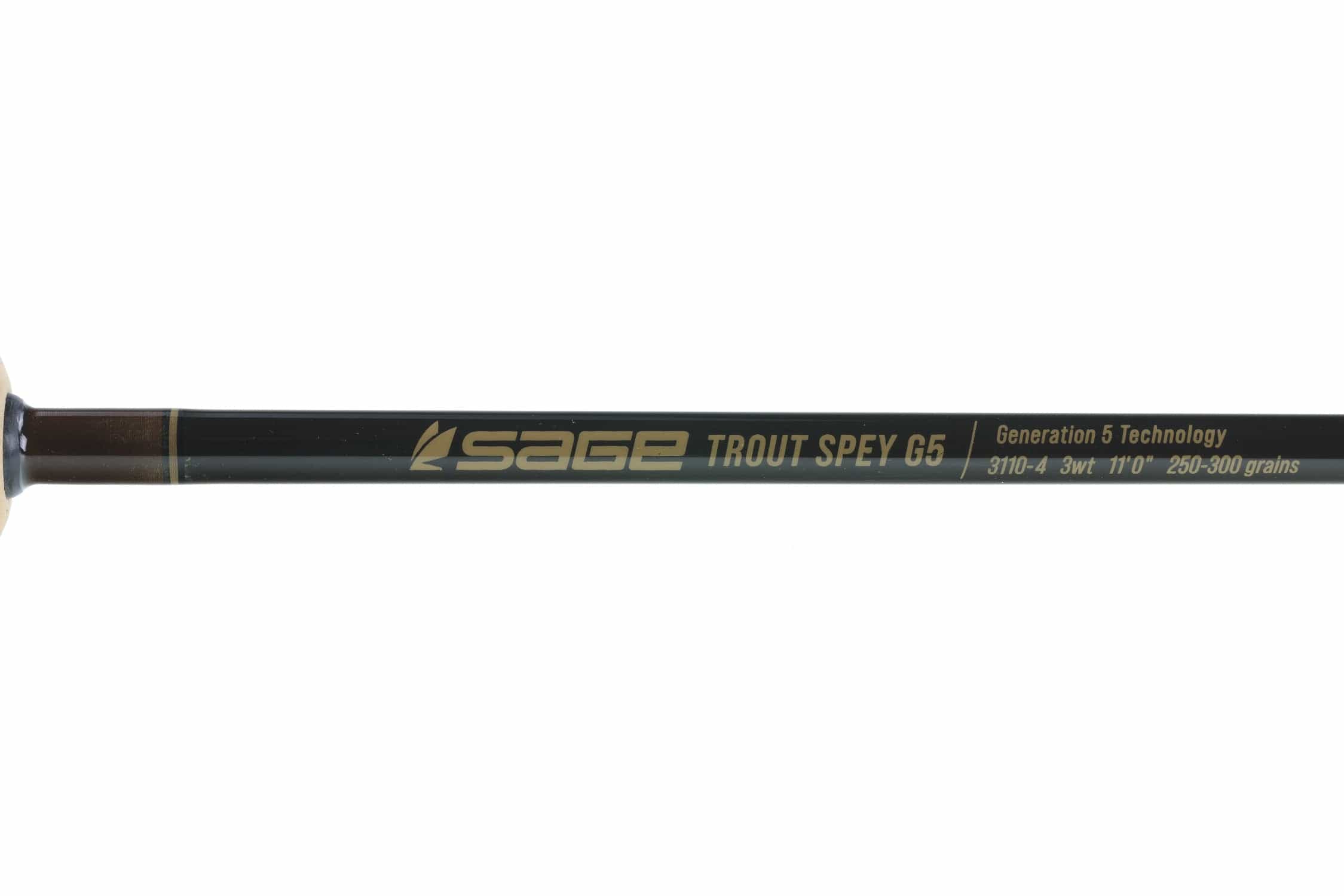
The family is three rods, all four piece and all built on a fast, trout spey specific action. The 3wt 11ft takes 250 to 300 grains and is the one Sage points new trout spey casters toward, since it swings soft hackles and moderately weighted streamers on the widest range of lines. The 4wt 11ft 3in takes 300 to 350 grains and is built around larger, more carnivorous trout and the bigger flies it takes to get their attention. The 5wt 11ft 6in takes 350 to 400 grains and carries the heaviest streamers and leeches, or a stiff wind. Every one is built on Bainbridge Island, Washington.
Blank
The G5 is built with Generation 5 technology, which Sage describes as an enhanced blank construction using a proprietary graphite hoop combined with minimal glass scrim. Scrim is the cross fiber that keeps a blank from ovaling and collapsing under load, and glass scrim does that job at a real weight cost. Replacing most of it with a graphite hoop is what lets Sage build a narrower shaft that is lighter and livelier without giving up hoop strength, and Sage's stated payoff is that you can feel the line load through the stroke.
That feedback is worth more on a two-hander than it is on a single hander. You get one stroke per cast and no false casts to correct with, so the rod telling you when the anchor has come tight and when the D-loop has formed is the difference between a clean cast and a ripped anchor. The action is listed as Fast, trout spey specific, which is the important qualifier: this is a taper designed at trout scale rather than a full-size spey taper cut down, and it is why the same blank handles a Skagit head and a sink tip in cold water and a short Scandi head with a long leader once the water warms. Cosmetically the blank is brown with Desert Olive primary thread wraps.
Guides
Stripping Guides - A Fuji ceramic ring stripper guide takes the first and hardest contact point. On a spey rod the entire running line fires through that guide in a single pass under full load on every cast, so friction there is measured in feet of distance. A ceramic insert is harder and slicker than a chromed frame and will not develop the grooves that shred line coating after a couple of seasons of grit.
Snake Guides - Hard chromed snake guides and tip-top run the length of the blank. Hard chrome resists the corrosion and abrasion of cold rain and snowmelt, and snakes add very little weight out toward the tip where mass costs the most on an 11ft blank. Sage sizes these guides specifically around current trout spey systems, so the welded loop where a head joins the running line, and the loop where a tip joins the head, clear on the retrieve instead of hanging up at a guide you cannot reach without breaking the rod down.
Reel Seat
The G5 uses a Gloss Black anodized aluminum down-locking reel seat. Down-locking is the correct configuration on a two-hander: it seats the reel behind your lower hand toward the butt, where its weight counterbalances the blank rather than hanging under your grip through a day of swinging. Anodized aluminum is the low-maintenance answer for a rod that lives in cold water and wet weather, with no wood insert to swell or check.
Ahead of it is a custom shaped fore and rear grip cork handle, listed by Sage as the Trout Spey Handle. The two separate grips are what make the rod two-handed: the fore grip carries your top hand through the sweep, and the rear grip gives your bottom hand the short lever that actually powers the forward stroke.
Rod Tube
The rod ships in a rugged brown nylon rod tube with a divided liner. The divider is the functional part: each of the four sections rides in its own channel, so ferrule ends and guide feet are not grinding against each other in transit. A nylon tube is also lighter and less prone to denting at the lip than thin-wall aluminum. Keep it, because Far Bank requires the entire rod, broken pieces included, to come back for any warranty or repair work.
Warranty
Every new Sage rod bought from an authorized dealer carries an original owner warranty against defects in materials and workmanship. Coverage is limited to repair or replacement of the rod, and Sage decides which, reserving the right to substitute a comparable model if yours is discontinued. It does not cover misuse, neglect, normal wear, fire, theft, missing or lost rod sections, intentional breakage, or modification of a finished rod. To make a claim the original owner sends the entire rod, including the broken pieces, freight paid and insured to Far Bank on Bainbridge Island. Rods with a serial number beginning with A or higher carry the original owner warranty; those with a serial number of Q, R, S or T carry an unconditional original owner lifetime warranty.
Breakage outside that coverage is repaired for a fee, and Far Bank tiers rod fees by the age of the model. As of August 2026 the published schedule is $50 for a current model, $95 for a recent one and $195 for a legacy rod, with $150 for a missing section. The Trout Spey G5 is in current production, so it falls at the first tier. Fee schedules change, so confirm the current figure with Far Bank when you file.
More Info
-
Rod Action: Fast, listed by Sage as trout spey specific
-
Best For: Swinging soft hackles and wet flies for trout, streamers and leeches on Skagit heads and sink tips, and covering big water without a back cast
-
Grip Style: Trout Spey Handle, custom shaped fore and rear grip cork, same style across all three models
-
Ability Level: Intermediate to Advanced
-
Line Weight Range: 3wt through 5wt, all 4 piece
-
Models: 3wt 11ft (2053-3110-4), 4wt 11ft 3in (2053-4113-4), 5wt 11ft 6in (2053-5116-4)
-
Grain Windows: 3wt 250-300gr, 4wt 300-350gr, 5wt 350-400gr
-
Blank: Generation 5 construction, brown with Desert Olive primary thread wraps
-
Reel Seat: Gloss Black anodized aluminum, down-locking
-
Rod Tube: Brown nylon with a divided liner
-
Made In: Bainbridge Island, Washington
Recommended Lines
Line this rod by grain weight, not by the number on the blank. Sage publishes a window for each model and they top out at 400 grains, which is below where most full-size Skagit and Scandi heads even begin, so a head borrowed from a steelhead rod is the single most common way people make a trout spey rod feel wrong. Sage does not build fly lines, and while Rio is Far Bank's sister brand, the grain number matters more than the badge.
The Scientific Anglers Spey Lite Skagit Head is the straightforward Skagit answer, a short aggressive taper designed for lightweight two-handed rods, which is exactly what turns over a sink tip and a weighted sculpin off a short stroke in cold water. Take 270gr or 300gr for the 3wt, 330gr for the 4wt, and 360gr or 390gr for the 5wt.
For the floating half of the season, skated caddis, soft hackles and long leaders, the Rio Elite Scandi Body Shooting Head covers all three rods with a longer front taper that lands a fly softly and suits touch and go casting. Use 250gr or 300gr on the 3wt, 325gr or 350gr on the 4wt, and 375gr or 400gr on the 5wt. Both of these are shooting heads, so budget for a running line as well.
If you would rather not build a system, the Rio Elite Integrated Trout Spey Line is a short head line with the running line already welded on, and it is the line Sage itself names on the 5wt product page. The 265gr sits in the middle of the 3wt window and the 350gr covers the top of the 4wt window and the bottom of the 5wt.