
































Did you find this video helpful? We've got hundreds more just like it. Subscribe to Trident's YouTube Channel and enhance your fly-tying skills. New videos are posted frequently in a variety of different patterns.
Ryan is back with us today to show us another essential fly that you should have in your predator box, the Pike Slider. This is a great fly because it really combines simplicity and practicality. The hackle tail offers fantastic movement, while the arrowhead-shaped head really gives this fly an excellent swimming action. If you are filling out a box for those toothy critters, be sure to have a few slots reserved in your box for the Pike Slider.
We've put together a kit that contains all the materials you need to tie this exact fly pattern.
Click the button below to shop the selection.
Materials:
Hook: Tiemco 600 SP (size 3/0)
Thread: Semperlfi Nano Silk (200D, White)
Tail: Hareline Strung Saddle Hackle (White)
Flash: Hedron Flashabou (Red)
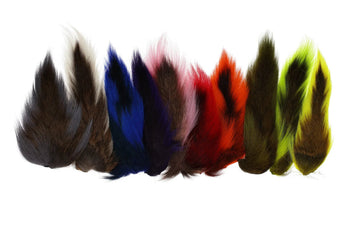
Head: Hareline Dyed Deer Belly Hair (White & Red)
Step 1

Begin by starting the thread at the hook eye and wrapping backward, ending between the hook point and the barb. Note: This pattern uses 200D GSP thread. Before spinning deer hair later in the pattern, flatten the thread by spinning your bobbin counter-clockwise. This allows you to apply maximum pressure when flaring the hair without cutting through the fibers.
Step 2

Select 2 feathers that are around 3–4 times the length of the hook shank. Marry the tips together so they are the same length, and tie them in on the side of the hook shank. Attach these so that the feathers are slightly flared out.
Step 3

Using 2 more feathers of the same length as the last 2, tie these in on the other side of the hook shank, making sure they are also slightly flared out. This slight flare improves the action of the feathers underwater.
Step 4

Tie in around 4–7 strands of Red Flashabou by folding the full length of flash around the thread at the halfway mark. Wrap over the center of the strands, then fold the forward-facing ends back over the tie-in point and secure with a few tight thread wraps. This double-layering technique locks the slippery flash in place so toothy critters like pike can't pull it free.
Step 5

Trim the flash around 1 inch shorter than the feather tips. This will help prevent fouling while not affecting the action of the fly.
Step 6


Select 2 webby saddle hackle feathers to create a veil that will help cover any thread wraps. Strip the base fibers, then tie the feathers in securely atop the hook shank using a few sturdy thread wraps. Palmer the feathers forward, folding the fibers back as you wrap to keep them from getting trapped. Once fully wrapped, use a bodkin or brush to release any fibers that may have been caught during the palmering process.
Step 9


Cut a generous clump of deer belly hair roughly the diameter of a pencil. Remove the underfur from the butts, then use a hair stacker to align the tips for a clean collar transition. Flatten your GSP thread before tying in. Tie the clump onto the top of the hook shank with two loose wraps, then gradually increase thread tension to spin and flare the deer hair evenly around the 360 degrees of the hook shank. Once the hair is fully flared and spun, pull the fibers back and build a tight thread dam in front to lock them in position.
Step 10


Cut a similar-sized clump of red deer belly hair and prepare it the same way. Use the spinning technique - two loose wraps followed by increasing thread tension - to flare and spin the hair around the shank. Pull the fibers back and build another thread dam to control and seat them. Consider stacking this red section on top and bottom rather than spinning it fully 360 degrees if you want a cleaner, more defined color band on the slider head.
Step 11


Using a slightly smaller clump of white deer belly hair, tie in one final section using the same spinning technique, ensuring the material flares fully around the shank. Keeping this final section slightly smaller helps maintain clean proportions and leaves enough room behind the hook eye to finish the fly. Make sure the hair is dispersed uniformly around the shank to keep the head of the fly balanced.
Step 12

Build a larger, tighter thread dam to force all the fibers back and fully define the front of the head. Once complete, use a whip finish tool to tie off the thread, then apply a small drop of head cement or UV resin for maximum durability.
Step 13

Begin trimming the head into a bullet or wedge/cone shape, with the taper pointing toward the hook eye. This is the defining characteristic of a slider - the tapered nose allows the fly to slice just under the surface film on the strip rather than popping aggressively like a standard popper. Take off small amounts of material at a time, working evenly around the entire head. Trimming tip: Rest the scissors on the hook eye as a guide to keep your cuts level and consistent.
Step 14

On the bottom of the fly, trim away material to create a completely flat base. This flat bottom improves hook-up ratios and helps the fly ride correctly through the water. For the cleanest result, use a double-edge razor blade bent slightly in the middle and draw it across the bottom of the head in one smooth, even pass.
Step 15
 The Pike Slider is now ready to fish. This pattern is highly versatile and can be tied in countless color combinations and sizes to target a wide variety of predatory species across different water types.

Comments
(0)No comments yet. Be the first!