Here at Trident Fly Fishing, we have a deep love for traditional Maine streamers, and few patterns turn heads on the water and on the bench quite like the Electric Chicken Flatwing. Developed in the classic flatwing style popularized along the rivers and lakes of Maine, this fly is a masterclass in sparse, suggestive tying that perfectly imitates smelt, a primary forage fish for brook trout and landlocked salmon throughout the region.
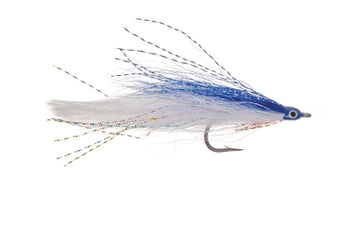
What makes the Electric Chicken so effective isn't just its bold color combination of chartreuse, pink, and white; it's the way those colors interact in the water. The white saddle hackles veil the intensity of the inner chartreuse and pink, creating a subtle, lifelike glow that mimics the flank of a baitfish. Tied on a long-shank streamer hook with a flashy Mylar body, the fly has just enough sparkle to draw attention without looking unnatural. It's a pattern that fish simply haven't seen many times before, and that novelty can make all the difference.
This is an especially productive fly during ice-out season in Maine, when salmon and trout move up high in the water column chasing schools of smelts. Whether you're swinging it through the pools of a classic salmon river or stripping it along the shoreline of a remote lake, the Electric Chicken Flatwing deserves a permanent spot in your streamer box. Follow along as Ryan breaks down each step of the tie so you can whip some up for next spring.
Welcome back everybody. It's Ryan again with [music] Trident Fly Fishing. I'm going to be tying a flat wing traditional Maine streamer in one of my favorite color [music] combos, which is the electric chicken. So, I'm going to start by tying in this black thread on this size four streamer hook. I am going to try to cover the most of the hook as I go. I'm going to leave a little bit of room behind the eye for the bucktail tie in at the end. I don't have to get every little piece of this covered cuz I am going to wrap tinsel or Mylar back over the shank. First material that I'm going to tie in is the ostrich herl. This is Robin's egg blue. Kind of thinner wispier ostrich. And um I'm going to take a little bit here from the very tip. Take four or five of those pieces. And kind of hold them together. And I want to just have this kicking off the back for a little bit of color. Like that. And I'm just going to cover that up a little bit. Cover up that blue. Good. Now I have that nice kind of color indicator in the back of the fly. Now I'm going to add some tinsel. And I want to cut off enough that I can wrap. This is a pretty long shanked hook, right? So, I want to make sure I when I cut off the tinsel or if I put it on if I take it off of the spool, I want to leave myself enough to cover that whole shank. So, I'm going to move a thread back to the front of the hook. And again, I'm leaving that a little bit of space cuz that's in the in the front here. That's where I'm going to tie in the bucktail and do the finish finishing touches of the fly. So, I'm going to have the the thread about 1/2 in behind the hook eye where I'm going to tie in the flat wing section, the saddles. So, I'm going to use my rotary vise once I get the first few wraps. My thread is chasing me here. Trying to cover that pretty completely as I go. Notice my thread is chasing me. I don't have my extension arm to hold my thread with me. So, I'm going to have to keep moving that over. No big deal. It'll just slow me down a little bit. And I can move the thread back and do this last little bit by hand. What I like about that black thread base is with this particular um color of tinsel you can see against that black thread, it gives us like bluish-green body. Um then I like that sort of like the dark but flashy center point and now it looks like a smelt. And in Maine, that's the primary forage fish for brook trout and and salmon. So again, I'm going to tie that in leaving that room knowing I'm going to need that space to tie in the bucktail at the end of the fly. Cool. It already has the kind of smelty color going on here. So, the trickiest part of this fly is when you have your you have your saddle hackles you're going to have to find I use four pieces. One chartreuse, one pink, and I put those two together, and then I take one piece or two pieces of white, so I have the chartreuse and the pink, and I have a white on either side of those. So, it's basically a sandwich with a chartreuse and the pink inside and the white feathers on the outside. And I've pre-clipped one here just to save time in the video. But, the order of like which is it the pink showing or the chartreuse doesn't really matter. I just have You can see the chartreuse and pink are on the inside, and I have white saddles on the outside. So, the white kind of veils the intensity of the color, but the color still comes through. Um this is a great color combination for all kinds of species, but it's a really good salmon fly in particular. I want this to be about the length of the fly with the tail. And again, the tie-in point is going to be here, not there. So, in that case, I might kind of pull forward some of the material on these saddles. I'm going to make a little cut here, knowing this is going to be shorter. And that's about right. This is the trickiest part of the fly because what happens is as I tie this in, there is a tendency for this material to want to do that, which is to splay out or to kind of twist around. So, you can do a pinch wrap. You can also turn it over in your hands cuz again, it doesn't really matter what side you're tying in. Couple of loose wraps. You can kind of position it. That's a little bit better. Good. Cool. So, now I have my flat wings in there. And you can kind of position them a little bit. You can kind of work with them a little to get the finishing touches on where they're located. And that's pretty darn good. So, those are four feathers are all sort of married together. And now I'm going to add some bucktail on the top and a little bit of this ostrich on the bottom here to finish off the fly. So, I'm going to take some pink uh bucktail and I think the mistake that folks make on this fly is they they use too much bucktail. This is pretty sparse. This is just a sort of accent and to give a little bit of like a the feeling of like a closed off top of a baitfish back above the flat wing part. So, I'm going pretty sparse here, right? Not much more than the width of It's less than the width of the fly itself. So, I'm going to cut to length. I want it to sort of be the same length as my flat wing tail. And I'm going to tie that in in here on top. Couple loose wraps. Good. And you'll notice sometimes if you tie too far back, it'll start to kind of smoosh your saddles down a little bit. So, you can kind of tease those back up as you go. Now, I'm going to take some of the chartreuse bucktail. Again, thinking sparse. Just enough to kind of create that nice veil on top and give that impression of the sort of roundedness of the top of the baitfish's back. Same idea. I'm kind of measuring it to length with what I've already tied in. Notice how sparse this is. Couple loose wraps to position it. Looks pretty darn good. Let's tie forward now. Great. Almost there. Now we have our flat wing section. We have our bucktail tied in on top. You can use your finger to kind of spread out that bucktail to kind of move it so that it's kind of covering the top part of the fly. Like so. Last little touch that I like to add, again this is just a touch of color, is a little bit more of the ostrich hurl. So, I'm going to find on this side I'm going to pull out probably eight or 10 quills. I'm going to have this coming off the bottom just to give a little bit more color. So, I'm going to spin this up. Couple loose wraps. And again, really sparse, but it just creates this nice little point of color. It's a beautiful fly. And now I have the flat wing part. I have the bucktail on top. I have this nice little accent color down on the bottom. And you'll notice here there's a little space on the head that I can tie back. See there's Here's the body. Here's the end of that tinsel, and there's a little bit of black thread there. So, I'm going to loosely try to cover that section without going too far back. That looks pretty good. One more wrap or two and I should cover that. That looks good. Great. So, I can kind of tease that down. That's looking good. And I can just finish off the head here. I want to kind of create that tapered finish with this black head. It's looking pretty good. This would be a great ice out fly in Maine for salmon and trout that are up high with chasing smelts. I'm going to whip finish here. The electric chicken. It's not a color combination that they're going to see very often, which I kind of like. I'm going to add just a little bit of this Hard as Hull to finish off the fly. There you have it. As always, all these materials are available at tridentflyfishing.com. Feel free to leave a comment below. Make sure you subscribe to our channel. Thanks for watching. That is the electric chicken flat wing Maine streamer.
Get the latest fly fishing tips & gear reviews
Comments
(1)
A
Andy Turner
Aug 17, 2026
I like the pattern. I will probably tie it for sea run cutthroat. I tie a craft fur or bucktail minnow in green chartreuse or hot green, yellow & pink that we call the clown. It is very effective on sea run cutthroat in saltwater. However, this fly is NOT a flat wing. It is not an old school flat wing like a Hornberg, a Wood Special or even a Nine Three. The classic Maine streamer, Nine Three when properly tied, has a pair of black hackles on edge over 3 green hackles tied flat from the head. Nor is it a modern flat wing as described by Joe Cordeiro. There’s nothing “flat” about this streamer in either of the two obvious fly tying meanings. Still a great pattern just not a flatwing.





















Comments
(1)I like the pattern. I will probably tie it for sea run cutthroat. I tie a craft fur or bucktail minnow in green chartreuse or hot green, yellow & pink that we call the clown. It is very effective on sea run cutthroat in saltwater. However, this fly is NOT a flat wing. It is not an old school flat wing like a Hornberg, a Wood Special or even a Nine Three. The classic Maine streamer, Nine Three when properly tied, has a pair of black hackles on edge over 3 green hackles tied flat from the head. Nor is it a modern flat wing as described by Joe Cordeiro. There’s nothing “flat” about this streamer in either of the two obvious fly tying meanings. Still a great pattern just not a flatwing.